
Breaking cycles
Love, Family, and Choosing Myself
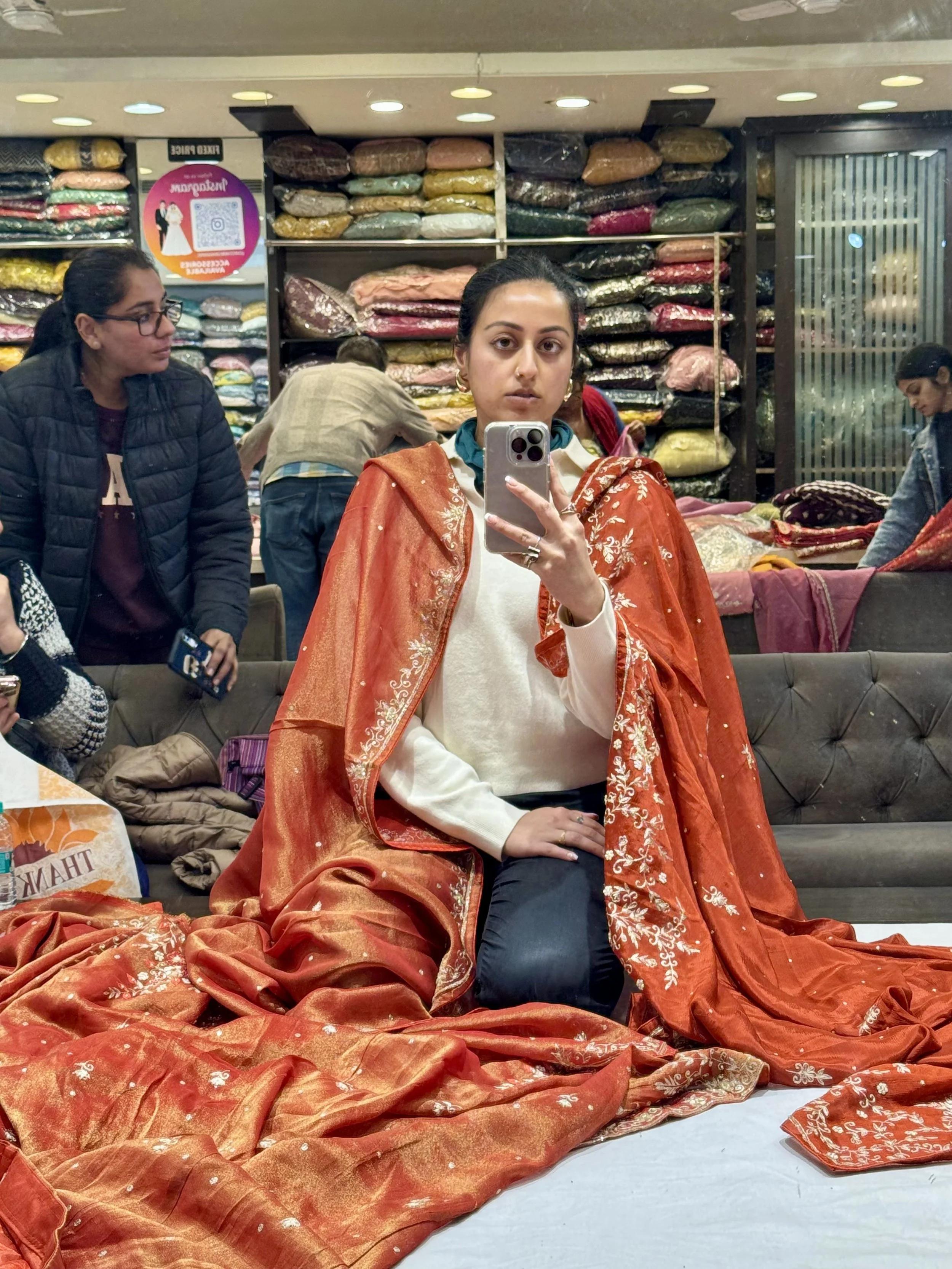
A major reason I went to Punjab this past January was to go wedding shopping with my mom and brother. If you had told me ten years ago that this moment would be possible, I don’t think I would have believed you.
For six of the ten years that Ali and I have been together, he was a secret from my family.
I love a definition of yoga that T.K.V. Desikachar gives in The Heart of Yoga—“Yoga is to attain what was previously unattainable. The starting point for this thought is that there is something that we are today unable to do; when we find the means for bringing that desire into action, that step is yoga. In fact, every change is yoga.”
You see, for as long as I can remember, my mom told me I had to marry a Punjabi Sikh (and Jatt) man. Even when I was as young as five years old, it was drilled into me. My future was predetermined: I would marry a Punjabi Sikh boy, move in with his family, and take on the role of the obedient wife and daughter-in-law—cooking, cleaning, serving.
I grew up watching what that looked like in reality. I saw it in my mom, my aunts, my grandmother, and the other women in my life—the way they ate last, the way they needed permission for everything, the way their power and autonomy were slowly stripped away. I saw it in the heavy hand my father wielded with me.
I knew intimately, at a young age, that I did not want this life for myself.
So when I met Ali in 2014—a man who is half Iranian, half Filipino—I knew I couldn’t tell my family. And I didn’t, not for six years. Even as Ali and I moved to Australia together in 2017, even as we built a life, I kept him hidden. The fear ran deep.
It wasn’t until 2019, with the support of my therapist, that I realized I couldn’t keep living this lie. By then, Ali wasn’t just someone I loved—he was my family. And if my blood family couldn’t accept him, I was ready to take that risk. I was prepared to be shunned, cast out.
Because I had grown up with that cautionary tale.
One of my cousins “ran away” with a white guy when she was 21, and for years, her story was held up as an example of what not to do. She was the “bad girl”, the one who had been cast out by her parents, who didn’t speak to her anymore. The one I was never supposed to become.
But through therapy, I began to untangle that programming:
I was not "bad" for choosing love outside of race, religion, and caste.
I did not owe my life to the expectations placed on me before I could even walk.
When I finally told my mom, I was prepared for the worst. I had already made peace with my decision. I knew Ali was my person, and nothing was going to change that. She went through all the stages of grief—anger, shock, denial, sadness—until, finally, acceptance.
And now, four years later, here we were. Wedding shopping together. There was a time I was convinced this moment would never come.
But these cycles don’t break without resistance. Even now, there are voices clinging to outdated ideas of control. One of my aunts, who I have not seen or spoken to in over seven years, heard about my engagement and immediately called my dad. She insisted I needed to break up with Ali—because he was Muslim.
When my mom told me, I could only laugh with disbelief at my aunt’s audacity.
This obsession with “log kya kahenge?”—What will people say?—is an epidemic in South Asian culture.
But my answer is simple: I do not ask for approval, validation, or advice from people I am not in relationship with and do not trust.
Because this is bigger than me and Ali.
It’s about every South Asian woman who has been made to believe that her worth is tied to obedience. That her life is not hers to live, but something to be molded by others.
It’s about every daughter who has watched the women before her shrink themselves to fit within lines they never drew.
It’s about every person who has been told that love must come with conditions—ones dictated by race, religion, caste, gender, or culture.
It’s about breaking cycles that were meant to keep us small.
And I know I’m not the only one doing this work.
I think of all the women before me who didn’t have the choice to marry for love, who didn’t have the freedom to walk away, who swallowed their dreams because survival demanded it.
And I think of all the women after me who, I hope, will never have to hide the people they love. Who will get to choose freely, without fear, without shame.
I choose them. I choose me.
And that choice is sacred.
This wedding, this love, this life I’ve chosen—it is mine.
And that, to me, is yoga: attaining what at one point seemed unattainable.